
Sunday, August 22, 2010
दवा-दारु


Wednesday, August 18, 2010
Delhi - Those Times and Lives - 4
(Continued excerpts from The Last Mughal by William Dalrymple)
But the biggest draw of all were the poets and intellectuals, men such as Ghalib, Zauq, Sahbai and Azurda: 'By some good fortune', wrote Hali, 'there gathered at this time in the capital, Delhi, a band of men so talented that their meetings and assemblies recalled the days of Akbar and Shah Jahan.' Hali's family tracked him down eventually, but before they found him, and hauled him back tio married life in the mofussil (provinces), he was able to gain admittance in the 'very spacious and beautiful' madrasa of Husain Bakhsh and to begin his studies there" 'I saw with my own eyes this last brilliant glow of learning in Delhi,' he wrote in old age, 'the thought of which now makes my heart crack with regret'.
Meanwhile, on Chandni Chowk, although Mr. Beresford, the manager of the Delhi Bank, had been at work since 9am, it was eleven o' clock before the first shopkeepers began turning up. They opened the shutters of their booths, fed their canaries and caged parakeets, and began fending off the first of the beggars and holy mendicants who bounced coins in their bowls as they passed up the gauntlet of shops. Some of these figures were well known and even revered Delhi characters, such as the Majzub (holy madman) Din Ali Shah: 'He is so careless about the addairs of this world,' wrote Sayyid Ahmad Khan in a sketch of Delhi's most famous citizens, 'that he remains naked most of the time and when surrounded by a crowd is likely to break out in to intemperate language. But when the desirous seekers ponder over the words, they find that behind the outward senselessness there is a clear answer to their queries'. Some of the most revered mendicants were women such as Baiji, 'a woman of exceptional talent who spent all her life under a a hay thatch near the Old Idgah of Shahjahanbad. While conversing she often quoted Quranic verses...whatever she had said would take place exactly as she predicted'.
Out on the pavements, tradesmen too humble to have their own premises were now filling their appointed places: the ear cleaner with this pick and probe, the tooth cleaner with his bundles of neem twigs, the astrologer with his cards and his parrot, the quack with his lizards and bottles of murky aphrodisiac oils, the kabutarwallah with his fantails and fancy doves. Meanwhile, in their workshops off the main street frontage, away from the eyes of the passes-by, the jewellers were preparing their emeralds and moonstones, topaz and diamonds, rubies from Burma, spinels from Badakshan and lapis from the Hindu Kush. Shoemakers took their cured leather and began curling the toes of their juties on the last; the sword-makers began lighting their forges, the cloth merchants pulled out their bolts of fabric; the spice merchants smoothed into shape their orange-gold mountains of turmeric.
In the largest premises of all, guarded by mace bearers, were the great Jain and Marwari moneylenders of Delhi with their family credit networks and groaning registers stuffed full of debtors' names, which included, after Mirza Jawan Bakht's wedding, Zafar himself. Down they slumped against their bolsters, dreaming of schemes for recovering the implausible sums of money they had so unwisely lent to the impecunious princes of the Red Fort - men like Lala Saligram, Bhawani Shankar and the richest of all, Lal Chunna Mal, the largest single investor in Mr. Beresford's Delhi Bank, in his massive and opulent haveli in Katra Nil.
Just as Chandni Chowk was waking up, 2 miles to the north, in the cantonment, the working day was already drawing to a close, and most of the soldierly duties were already completed. A bathe, a quick read of the papers and a game of billiards filled an hour or two, before the heat in the small brick bachelor bungalows became unbearable and all that remained to do until late afternoon was to sprawl around in "loose dishabille, reading, lounging and sleeping'. With little to occupy them most of the day, for many British soldiers boredom was the principal enemy they faced in India.
(Contd)
Also in the series:
Delhi - Those Times and Lives - 1
Delhi - Those Times and Lives - 2
Delhi - Those Times and Lives - 3
 |
| Mirza Ghalib |
.jpg) |
| Chandni Chowk (By Michael Kluckner) |
Out on the pavements, tradesmen too humble to have their own premises were now filling their appointed places: the ear cleaner with this pick and probe, the tooth cleaner with his bundles of neem twigs, the astrologer with his cards and his parrot, the quack with his lizards and bottles of murky aphrodisiac oils, the kabutarwallah with his fantails and fancy doves. Meanwhile, in their workshops off the main street frontage, away from the eyes of the passes-by, the jewellers were preparing their emeralds and moonstones, topaz and diamonds, rubies from Burma, spinels from Badakshan and lapis from the Hindu Kush. Shoemakers took their cured leather and began curling the toes of their juties on the last; the sword-makers began lighting their forges, the cloth merchants pulled out their bolts of fabric; the spice merchants smoothed into shape their orange-gold mountains of turmeric.
 |
| Chunnamal Haveli today (taken from Wikipedia) |
Just as Chandni Chowk was waking up, 2 miles to the north, in the cantonment, the working day was already drawing to a close, and most of the soldierly duties were already completed. A bathe, a quick read of the papers and a game of billiards filled an hour or two, before the heat in the small brick bachelor bungalows became unbearable and all that remained to do until late afternoon was to sprawl around in "loose dishabille, reading, lounging and sleeping'. With little to occupy them most of the day, for many British soldiers boredom was the principal enemy they faced in India.
(Contd)
Also in the series:
Delhi - Those Times and Lives - 1
Delhi - Those Times and Lives - 2
Delhi - Those Times and Lives - 3
Saturday, August 14, 2010
64th Independence Day - Hope and Despair
On the eve of 64th anniversary of Indian Independence Day, my feelings alternate between hope and despair.
I am filled with hope when I realise that I am a citizen of the great democratic republic of India, which is a political & economic superpower in the making, taking great strides towards occupying a major role in the world order sooner than later.
Ominous clouds of despair, however, surround me when I realise how hollow these achievements sound in the deafening cries of burning Kashmir, Maoist violence, corrupt political and social system, hunger, poverty...a country failed by its people - us.
While I contemplate which of these two Indias is a reality, I am sure of one thing - I am proud to be an Indian!

Here is wishing you a very Happy Indian Independence Day!
I am filled with hope when I realise that I am a citizen of the great democratic republic of India, which is a political & economic superpower in the making, taking great strides towards occupying a major role in the world order sooner than later.
Ominous clouds of despair, however, surround me when I realise how hollow these achievements sound in the deafening cries of burning Kashmir, Maoist violence, corrupt political and social system, hunger, poverty...a country failed by its people - us.
While I contemplate which of these two Indias is a reality, I am sure of one thing - I am proud to be an Indian!

Here is wishing you a very Happy Indian Independence Day!
Sunday, August 08, 2010
Delhi - Those Times and Lives - 3
(Continued excerpts from The Last Mughal by William Dalrymple)
By now in the city itself, in the high-walled privacy of the courtyards of the grander houses like that of the young courtier Zahir Dehalvi in Matia Mahal, the servants were beginning to stir, throats were being cleared, and bamboo blinds were being rolled up to reveal water channels and fountains in the cloister gardens. Soon bolsters and sheets were being tidied away to leave the verandas of the courtyard free for breakfast - of mangoes or aloo puri for the Hindus, or perhaps some mutton shorba for the Muslims. Servants would draw water from wells, or head out to buy fresh melons from the Sabzi Mandi; in some of the richer houses coffee might be prepared. From the masculine side of the house came the first gurgle of the hookah. In the zenana, children were being dressed, cholis, ghagras and angiyas buttoned and laced, peshwaz and saris wrapped. In the kitchen the daily ritual of chopping onions, chillies and ginger would begin, and the chickpeas and channa dal set to soak; elswhere, the different inhabitants of the zenana would begin their day praying, sewing, embroidering, cooking or playing.
(OldIndianPhotos.BlogSpot.com).jpg) |
| Photo source: oldindianphotos.blogspot.com |
'Perhaps, there are few communities in the world among whom education is more generally diffused than among Muhammadans in India', he wrote on a visit to the Mughal capital.
He who holds an office worth twenty rupees a month commonly gives his sons an education equal to that of a prime minister. They learn through the medium of Arabic and Persian languages what young men in our colleges learn through those of Greek and Latin - that is grammar, rhetoric, and logic. After his seven years of study, the young Mohammadan binds his turban upon a head almost as well filled with the things which appertain to these branches of knowledge as the young man raw from Oxford - he will talk as fluently about Socrates and Aristotle, Plato and Hippocrates, Galen and Avicenna; (alias Sokrat, Aristotalis, Aflatun, Bokrat, Jalinus and Bu Ali Sena); and, what is much to his advantage in India, the languages in which he has learnt what he knows are those which he most requires through life.
The reputation of Delhi madrasas was certainly sufficient to inspire the young poet Altaf Husain Hali to flee his marriage in Panipat and walk fifty-three miles to Delhi alone and penniless and sleeping rough in an attempt to realise his dream of studying in the famous colleges there: 'Everyone wanted me to look for a job', he wrote later, ' but my passion for learning prevailed.' Delhi was after all a celebrated intellectual centre and in the early 1850s, it was at the peak of its cultural vitality. It had six famous madrasas and at least four smaller ones, nine newspapers in Urdu and Persian, five intellectual journals published out of the Delhi College, innumerable printing presses and publishers, and no fewer than 130 Unani doctors. Here many of the new wonders uncovered by Western science were being translated for the first time in to Arabic and Persian, and in the many colleges and madrasas the air of intellectual open mindedness and excitement was palpable.
Also in the series:
Delhi - Those Times and Lives - 1
Delhi - Those Times and Lives - 2
Sunday, August 01, 2010
कल शाम
बारिशों के धुले धुले, खुशनुमा मौसम में अपनी एक पुरानी कविता याद आयी है, सो लगा रहा हूँ -
कल शाम
जब प्रकृति मुस्कुराई थी,
जब बादल फट पड़े थे
अपने अंतर को उड़ेलते से
और यह हवा कुछ पगलाई थी.
याद है?
उन पत्तों पर तैरती बूंदों की रुनझुन
खिड़की के शीशे पर
पानी की एक बहती लकीर,
और हवा में तैरता भीगा सा मल्हार -
जब फुहारें आँगन में बिखर आयी थीं.
बरसाती मिटटी की वह सोंधी महक
रौशनी से खेल करता, वह नाचता कूदता कोहरा
व्योम के सीने पर चमकते, कौंधते बिजली के खंडग
छातों, बरसातियों के नीचे दबी ज़िन्दगी,
सब कुछ रेंगता सा, खिसकता सा
लेकिन खुशनुमा फिर भी.
कल शाम जब...
 |
कल शाम
जब प्रकृति मुस्कुराई थी,
जब बादल फट पड़े थे
अपने अंतर को उड़ेलते से
और यह हवा कुछ पगलाई थी.
याद है?
उन पत्तों पर तैरती बूंदों की रुनझुन
खिड़की के शीशे पर
पानी की एक बहती लकीर,
और हवा में तैरता भीगा सा मल्हार -
जब फुहारें आँगन में बिखर आयी थीं.
बरसाती मिटटी की वह सोंधी महक
रौशनी से खेल करता, वह नाचता कूदता कोहरा
व्योम के सीने पर चमकते, कौंधते बिजली के खंडग
छातों, बरसातियों के नीचे दबी ज़िन्दगी,
सब कुछ रेंगता सा, खिसकता सा
लेकिन खुशनुमा फिर भी.
कल शाम जब...
Wednesday, July 28, 2010
Delhi - Those Times and Lives - 2
(Continued excerpts from The Last Mughal by William Dalrymple)
As the cantonment memsahibs awaited the return of their menfolk from the parade ground, inside the city walls Padre Jennings would be conducting the early morning service in the hush of St. James Church. Soon the courts to one side of the graveyard would come to life too: the two chief magistrates, John Ross Hutchinson and Charles Le Bas, would already be in their offices, as would their assiduous assistant, Arthur Galloway, and the Sadr Amin Mufti Sadruddin, often known by his pen-name Azurda. At the same time, riding in through Kashmere Gate, Theo Metcalfe, the other joint magistrate, would be
heading late towards his day's work, regretting that he had not prepared his briefs as thoroughly as he might have, and that he had not been up as early as his father, who had already conducted half his day's business, besides taking a swim, organising the household and reading the papers. George Wagentrieber would be up too. Having kissed his wife Elizabeth goodbye, he would now, like Theo, be heading down from the Civil Lines to the Kashmiri Gate offices of the Delhi Gazette, to begin his day of writing and proofreading the latest issue.
Among the people of Delhi, the poor woke long before the rich. As the sun rose, and as the British were returning from their morning rides and preparing for breakfast, up near the shrine of Qadam Sharif, the first bird catchers were laying their nets and baiting them with millet, to catch the early birds out for their morning feed. Past them on the dusty road came the sellers of fruit and vegetables, some on bullock carts, most trudging on foot, streaming in from the villages of the Doab down the Alipore road, bringing their goods to the new suburb of Sabzi Mandi just outside the Kabul Gate, to the north-west of the city.
At the Raj Ghat, the earlier-rising Hindu faithful - at this time of day women in their cotton saris far outnumbering the men - were streaming out to perform their pujas and have their morning bathe in the waters of the holy Yamuna before the crowds gathered and the dhobis appeared. Only the pandits kept them company this early in the morning: in small shrines lining the banks of the river up to Nigambodh Ghat, where according to Delhi legend the Vedas emerged from the waters, the bells were ringing now for the morning Brahm Yagya, celebrating the creating and re-creating of the world over and over again, morning after morning. As the differently pitched bells sounded against the Sanskrit chants, so in the dark of the inner sanctum the camphor lamps circled the images of Vishnu and the marigold-strewn black stone Shiva lingams.
From deep inside the city - from the Maszid Kashmiri Katra in the south to Fatehpuri Maszid in the west, to the great Jama Maszid itself and on through to the elegant riverside minarets of the Zinat-ul-Masajid - the last cries of the dawn Azan could now be heard, each call slightly out of time with the one before it, so that the successive cries of spiritual longing and assertion came to the listener on the riverbank in a series of rolling waves. In the silence that followed the end of the call to prayer, the songs of the first Delhi birds could suddenly be heard: the argumentative chuckle of the babblers, the sharp clatter of the mynahs, the alternating clucking and squealing of the rosy parakeets, the angry exclamation of the brain fever bird, and from deep inside the canopy of the fruit trees in Zafar's gardens at Raushanara Bagh and Tis Hazari, the woody hot-weather echo of the koel.
(To be continued..)
Also in the series:
Delhi - Those Times and Lives - 1
About the sketches and paintings
The paintings I have used in this post are by two artists - Michael Kluckner and Jon Duplock.
Michael is a Canadian artist and writer while Jon is an English artist. Both of them have painted / sketched India in their different styles. Both have gracefully allowed me to use these images.
For more details, you could visit their websites mentioned below their works.
.jpg) |
| (Picture Courtesy: i.dailymail.co.uk) |
heading late towards his day's work, regretting that he had not prepared his briefs as thoroughly as he might have, and that he had not been up as early as his father, who had already conducted half his day's business, besides taking a swim, organising the household and reading the papers. George Wagentrieber would be up too. Having kissed his wife Elizabeth goodbye, he would now, like Theo, be heading down from the Civil Lines to the Kashmiri Gate offices of the Delhi Gazette, to begin his day of writing and proofreading the latest issue.
.jpg) |
| Painting by Canadian artist and writer Michael Kluckner (michaelkluckner.com) |
.jpg) |
| "Puja" painting by English artist Jon Duplock, 2009 (jonduplock.com/) |
From deep inside the city - from the Maszid Kashmiri Katra in the south to Fatehpuri Maszid in the west, to the great Jama Maszid itself and on through to the elegant riverside minarets of the Zinat-ul-Masajid - the last cries of the dawn Azan could now be heard, each call slightly out of time with the one before it, so that the successive cries of spiritual longing and assertion came to the listener on the riverbank in a series of rolling waves. In the silence that followed the end of the call to prayer, the songs of the first Delhi birds could suddenly be heard: the argumentative chuckle of the babblers, the sharp clatter of the mynahs, the alternating clucking and squealing of the rosy parakeets, the angry exclamation of the brain fever bird, and from deep inside the canopy of the fruit trees in Zafar's gardens at Raushanara Bagh and Tis Hazari, the woody hot-weather echo of the koel.
(To be continued..)
Also in the series:
Delhi - Those Times and Lives - 1
About the sketches and paintings
The paintings I have used in this post are by two artists - Michael Kluckner and Jon Duplock.
Michael is a Canadian artist and writer while Jon is an English artist. Both of them have painted / sketched India in their different styles. Both have gracefully allowed me to use these images.
For more details, you could visit their websites mentioned below their works.
Thursday, July 22, 2010
वाह ताज बोलिए!
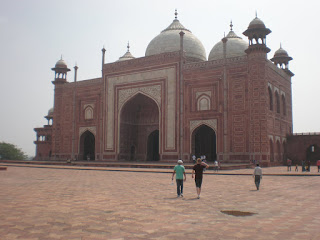
पिछले सप्ताहांत आगरा और फतेहपुर सीकरी हो कर लौटा हूँ. ताजमहल, सिकन्दरा (अकबर का मकबरा) और फतेहपुर सीकरी देख कर.
जी, पहली बार.
ताजमहल की हजारों तस्वीरों ज़ेहन में लिए हुए था. फिर भी, असल चीज को देखना एक भौंचक्का कर देने वाला अनुभव था.
पूर्वी दरवाजे से पहली झलक में ऐसा लगा जैसे अँधेरे के पार एक जादुई संसार चमक रहा हो. और इस शानदार ईमारत के रु-ब-रु हो कर तो वाकई माना कि इसे संगमरमर में ग़ज़ल यूं ही नहीं कहा गया है. यह फख्र होता है कि दुनिया के पर्यटन नक़्शे पर इतनी कद्दावर निशानी हमारे पास है.
पर इसको दुनिया को परोसने के लिए थोड़ी मेहनत और करने की ज़रुरत है.
कमोबेश यही हालत फतेहपुर सीकरी और सिकन्दरा की है.
दोनों शानदार जगह हैं. पर अब नए ज़माने के लिए इन्हें, कहना चाहिए कि थोडा user - friendly बनाना चाहिए.
नए, पढ़े-लिखे, इतिहास में रुचि रखने वाले गाइड हों, कुछ ऑडियो-विजुअल तकनीक की मदद हो, गंदगी कम हो, बिजली की व्यवस्था पूरी हो (ताजमहल का संग्रहालय हम इसी लिए नहीं देख पाए क्यूंकि बिजली नहीं थी)... कुल मिला कर देखने वाले के समक्ष वो पुराना संसार जीवित कर देने की ललक और समझ हो तो क्या बात हो.
पर फिर भी, वाह ताज! तो कहा जायेगा, और अब पूर्णिमा की इक रात को वापिस आने का मौका तलाशा जायेगा.
लीजिये, कुछ तस्वीरें नज़र हैं -


 अकबर के मकबरे के भीतर से बाहर की ओर




जी, पहली बार.
ताजमहल की हजारों तस्वीरों ज़ेहन में लिए हुए था. फिर भी, असल चीज को देखना एक भौंचक्का कर देने वाला अनुभव था.
पूर्वी दरवाजे से पहली झलक में ऐसा लगा जैसे अँधेरे के पार एक जादुई संसार चमक रहा हो. और इस शानदार ईमारत के रु-ब-रु हो कर तो वाकई माना कि इसे संगमरमर में ग़ज़ल यूं ही नहीं कहा गया है. यह फख्र होता है कि दुनिया के पर्यटन नक़्शे पर इतनी कद्दावर निशानी हमारे पास है.
पर इसको दुनिया को परोसने के लिए थोड़ी मेहनत और करने की ज़रुरत है.
कमोबेश यही हालत फतेहपुर सीकरी और सिकन्दरा की है.
दोनों शानदार जगह हैं. पर अब नए ज़माने के लिए इन्हें, कहना चाहिए कि थोडा user - friendly बनाना चाहिए.
नए, पढ़े-लिखे, इतिहास में रुचि रखने वाले गाइड हों, कुछ ऑडियो-विजुअल तकनीक की मदद हो, गंदगी कम हो, बिजली की व्यवस्था पूरी हो (ताजमहल का संग्रहालय हम इसी लिए नहीं देख पाए क्यूंकि बिजली नहीं थी)... कुल मिला कर देखने वाले के समक्ष वो पुराना संसार जीवित कर देने की ललक और समझ हो तो क्या बात हो.
पर फिर भी, वाह ताज! तो कहा जायेगा, और अब पूर्णिमा की इक रात को वापिस आने का मौका तलाशा जायेगा.
लीजिये, कुछ तस्वीरें नज़र हैं -

सिकन्दरा (अकबर का मकबरा)

सिकन्दरा का मुख्य (दक्षिण) दरवाज़ा


बुलंद दरवाज़ा (फतेहपुर सीकरी)

फतेहपुर सीकरी के भीतर

शेख सलीम चिश्ती की दरगाह

सीकरी का दरवाज़ा

ताज का पूर्वी दरवाज़ा

पहली झलक

वाह ताज!

वाह ताज - एक बार फिर!

एक मीनार

हाथ छुए तो गात मैला हो!

ताज के बराबर में मेहमानखाना

ताज के बराबर में मस्जिद

अक्स
Friday, July 16, 2010
तालिबानी ऑटो? या, Your friendly neighborhood agony aunt?

(चित्र के लिए माधव को धन्यवाद)
Sunday, July 11, 2010
Delhi - Those Times and Lives - 1
In my post The Last Mughal, I had promised that I would serialize the portions of this book by William Dalrymple, depicting the daily lives of the Dilliwalas of those times - Indians and English.
This is the first in the series - Enjoy!
 (Painting - Delhi Gate; taken from the Wikipedia)
During the early 1850s, it sometimes seemed as if the British and the Mughals lived not only in different mental worlds, but almost in different time zones.
The British were the first up: in the cantonments to the north of the Delhi civil lines, the bugle sounded at 3.30 a.m., a time when the poetic mushairas of the Mughals were still in full flow in the Red Fort, and while in the kothis of the courtesans in Chauri Bazar the dancing and ghazal singing were drawing to a close, and the girls were progressing to the more intimate stage of their duties. As the Mughal poets and courtesans raised their different tempos, sleepy, yawning Englishmen like Captain Robert Tytler, a fifty year old veteran of the 38th Native Infantry, or Lieutenant Harry Gambier, an eighteen-year-old Etonian newly arrived in India, would be sitting up in bed as their servants attempted to shave them and pull on their master's stockings. A long session of drill in the cantonment parade ground lay ahead.
Two hours later, by the time the sun was beginning to rise over the Yamuna, and the poets, the courtesans and their patrons were all heading back to bed to sleep off their long nights, not only the soldiers but also the British civilians would be up and about and taking their exercise. A woman like Harriet Tytler, the brisk and no-nonsense wife of Robert, or the English community's great beauty, the lovely young Annie Forrest, to whom Harry Gambier was already writing politely admiring letter, would have been back from their morning rides round the cantonment: in order to protect a lady's complexion, it was considered advisable to ride much after sunrise.
By six, Harriet would be busy supervising her large staff of servants in her screen-darkened bungalow. The first task was preparing for the enormous breakfast without which no English-man in Victorian India would consider starting his day: at the very least a selection of 'crumbled chops, brain cutlets, beef rissoles, devilled kidneys, whole spatchcocks, duck stews, Irish stews, mutton hashes, brawn of sheep's heads and trotters, not to mention an assortment of Indian dishes such as jhal-frazie, prawn do-piaza, chicken malai and beef Hussainee. Added to the list were a number of Anglo-Indian concoctions such as kidney toast Madras style, Madras fritters, and leftover meat minced and refried with ginger and chillies. Then of course there was the ultimate Anglo-Indian breakfast dish of kedgeree, a perennial favourite, even though in Delhi it was considered most inadvisable to eat fish in high summer*.
(*From the footnote: Overeating remained a leitmotif of British life in India right up to 1947. As late as 1926 Aldous Huxley was astonished by the sheer amount of food the imperial British were capable of consuming: 'Five meals a day - two breakfasts, luncheon, afternoon tea and dinner - are standard throughout India. A sixth is often added in the big towns where there are theatres and dances to justify late supper. The Indian who eats at most two meals a day, sometimes only one - too often none - is compelled to acknowledge his inferiority...The Indians are impressed by our gastronomic prowess. Our prestige is bound up with overeating. For the sake of empire the truly patriotic will sacrifice his liver and his colon, will pave the way for future apoplexies and cancers of the intestine...)
To be continued
This is the first in the series - Enjoy!

During the early 1850s, it sometimes seemed as if the British and the Mughals lived not only in different mental worlds, but almost in different time zones.
The British were the first up: in the cantonments to the north of the Delhi civil lines, the bugle sounded at 3.30 a.m., a time when the poetic mushairas of the Mughals were still in full flow in the Red Fort, and while in the kothis of the courtesans in Chauri Bazar the dancing and ghazal singing were drawing to a close, and the girls were progressing to the more intimate stage of their duties. As the Mughal poets and courtesans raised their different tempos, sleepy, yawning Englishmen like Captain Robert Tytler, a fifty year old veteran of the 38th Native Infantry, or Lieutenant Harry Gambier, an eighteen-year-old Etonian newly arrived in India, would be sitting up in bed as their servants attempted to shave them and pull on their master's stockings. A long session of drill in the cantonment parade ground lay ahead.
Two hours later, by the time the sun was beginning to rise over the Yamuna, and the poets, the courtesans and their patrons were all heading back to bed to sleep off their long nights, not only the soldiers but also the British civilians would be up and about and taking their exercise. A woman like Harriet Tytler, the brisk and no-nonsense wife of Robert, or the English community's great beauty, the lovely young Annie Forrest, to whom Harry Gambier was already writing politely admiring letter, would have been back from their morning rides round the cantonment: in order to protect a lady's complexion, it was considered advisable to ride much after sunrise.
By six, Harriet would be busy supervising her large staff of servants in her screen-darkened bungalow. The first task was preparing for the enormous breakfast without which no English-man in Victorian India would consider starting his day: at the very least a selection of 'crumbled chops, brain cutlets, beef rissoles, devilled kidneys, whole spatchcocks, duck stews, Irish stews, mutton hashes, brawn of sheep's heads and trotters, not to mention an assortment of Indian dishes such as jhal-frazie, prawn do-piaza, chicken malai and beef Hussainee. Added to the list were a number of Anglo-Indian concoctions such as kidney toast Madras style, Madras fritters, and leftover meat minced and refried with ginger and chillies. Then of course there was the ultimate Anglo-Indian breakfast dish of kedgeree, a perennial favourite, even though in Delhi it was considered most inadvisable to eat fish in high summer*.
(*From the footnote: Overeating remained a leitmotif of British life in India right up to 1947. As late as 1926 Aldous Huxley was astonished by the sheer amount of food the imperial British were capable of consuming: 'Five meals a day - two breakfasts, luncheon, afternoon tea and dinner - are standard throughout India. A sixth is often added in the big towns where there are theatres and dances to justify late supper. The Indian who eats at most two meals a day, sometimes only one - too often none - is compelled to acknowledge his inferiority...The Indians are impressed by our gastronomic prowess. Our prestige is bound up with overeating. For the sake of empire the truly patriotic will sacrifice his liver and his colon, will pave the way for future apoplexies and cancers of the intestine...)
To be continued
Tuesday, July 06, 2010
The Why of Painting
Following is a beautiful quote by the renowned American painter Robert Henri, which I stumbled upon on the internet while researching some paintings.
Such a sublime truth it states with so much simplicity, that I could not resist sharing it with you. Here it is:
" The object of painting a picture is not to make a picture - however unreasonable this may sound. The picture, if a picture results, is a by-product and may be useful, valuable and interesting as a sign of what has passed.
The object which is at the back of every true work of art, is the attainment of a state of being, a state of high functioning, a more than ordinary moment of existence."
 (A painting by Robert Henri taken over internet from Artnet.com)
Such a sublime truth it states with so much simplicity, that I could not resist sharing it with you. Here it is:
" The object of painting a picture is not to make a picture - however unreasonable this may sound. The picture, if a picture results, is a by-product and may be useful, valuable and interesting as a sign of what has passed.
The object which is at the back of every true work of art, is the attainment of a state of being, a state of high functioning, a more than ordinary moment of existence."

Sunday, July 04, 2010
The Last Mughal

After the White Mughals and City of Djinns, the third book by William Dalrymple, which I have just finished reading, is The Last Mughal. And yet again, I have been rewarded with a thoroughly satiating, enjoyable & of course, hugely informative, read. It is painstakingly researched history served akin to an interesting story – complete with a thrilling plot, fleshed out characters, detailed atmosphere and background, and an end full of pathos.
The Last Mughal is a heart-rending account of the historical events in Delhi during 1857, when emperor Bahadur Shah Zafar of the once mighty Mughal emperor made one last attempt to reclaim its fast fading glory from the British, by riding on the crest of Uprising of the Indian sepoys employed with the East India Company.
In absence of a strong leadership and a cohesive and sustained attack, however, the initiative of the rebels was soon lost, leading to the British company giving a final death blow to the Mughal empire. Bahadur Shah Zafar was deported with his family like an ordinary criminal to another British colony Rangoon, where he died unknown some years later. It was after this that the British became the undisputed masters of the whole of India for the next century or so. Interestingly, let me also put, it seems the idea of India actually took a shape after this.
The Last Mughal is as much a story of the city of Delhi as it is of Bahadur Shah Zafar, the last Mughal emperor. The renowned author Khushwant Singh is right when he says in his appreciation of the book that it would “bring tears to the eyes of every true Dilliwallah”.
William Dalrymple has this rare ability (for a historian, that is) of bringing empathy to not only the human characters but also to the city, as an organic being, a living pulsating whole of people. With insightful interpretations of volumnious notes, and riding on a beautiful language, he has created the Delhi of yore as also the detailed sequence of events beautifully.
There are two Delhis, in fact. One is the Mughal Delhi of Lal Qila, Ballimaran, Paharganj et al, engrossed in its mushairas, mehfils, kabootarbaazi, bazaars and the like. The other is English Delhi, a sort of a little English town the Company were trying to recreate in and around the Metcalfe House, Ludlow Castle, Civil Lines, Flagstaff Tower etc, with their chhota haaziri and Sunday Mass and breakfasts. And both of them, although living side-by-side, are miles apart in their living styles. (Chapter 3 "An Uneasy Equilibrium" consists such a beautiful juxtaposition of their daily lives, which I would like to serialise for your reading pleasure sometime soon).
Along with all this empathy, Dalrymple succeeds in maintaining a complete objectivity as a historian towards all the principal casts of characters, which puts lots of things in perspective.
While strongly recommending this book, I would go so far as to say that it is time the "dry-as-dust" history books in our educational curriculum were replaced with such elegant narrative history, so that an entire generation could understand its historical coordinates more meaningfully.
Sunday, June 13, 2010
Jai Badri Vishaal
चरण, शरण गुरु, एक पैंडा* जाए चल,
 ,
, 


 Ganga enroute
 Har Ki Pauri, Haridwar
 The Ganga Jal Seller
 Inscription Near Village Mana
 The Bazaar in Haridwar
 The Sadhus at Work
 The Sadhu Waiting for Work

A typical house in Mana
 Need I say something?
सतगुरु कोट* पैंडा अग्गे होए लेत है.
* पैंडा - कदम; *कोट - सहस्त्र, हज़ार
(Only the first step towards the refuge of the Guru, the believer needs take;
And He comes forward a thousand steps to receive and carry you along)
I am just back after paying my obeisance at one of the holiest Hindu shrines - Shree Badrinath, and the above beautiful baani from the Holy Gurbani of the Sikhs best describes what I acutely feel when I recall the multitudes of people thronging this mountain temple - some of them barely able to walk, others with nothing to shield themselves from the icy winds, yet others infirm with age or disease - but all of them having reached here to pray at the abode of their God .
Badrinath is a small temple town in the Himalayas on the banks of the mighty Alaknanda river and although one of the rather easily accessible dhams, it still takes 12 hours of an arduous uphill journey from Haridwar, full of treacherous roads, high mountains, deep gorges, lush green valleys, and of course an occasional impatient driver.
Once you reach the dham, however, the effort seems worth it. I do not consider myself religious in the strictest sense of the word but there surely flows some divine undercurrent which charges your inner being. Then, the systematic arrangements in the temple, including an option of participation in aartis (prayers) to choose from, and the absence of pandas are a pleasant surprise.
Just 3 kms ahead of Badrinath is the village Mana, which is the last Indian village before the Chinese border 30 kms ahead. This village also houses the ancient Ganesh Gufa, the cave where supposedly the great epic Mahabharata was penned by Lord Ganesh. Owing to both these reasons, this village is also a great tourist attraction. The great Sikh pilgrimage site – Hemkund Sahib also lies enroute to Badrinath.
Notwithstanding your religious inclination, Badrinath is a place to be visited at least once, what with all the natural beauty spread around. All the travel information is easily available on the internet. What I would only suggest is to give a serious thought to book through the government tourism agency GMVNL (Garwhal Mandal Vikas Nigam Limited), which I found to be surprisingly efficient with probably the most cost-effective and reliable arrangements.
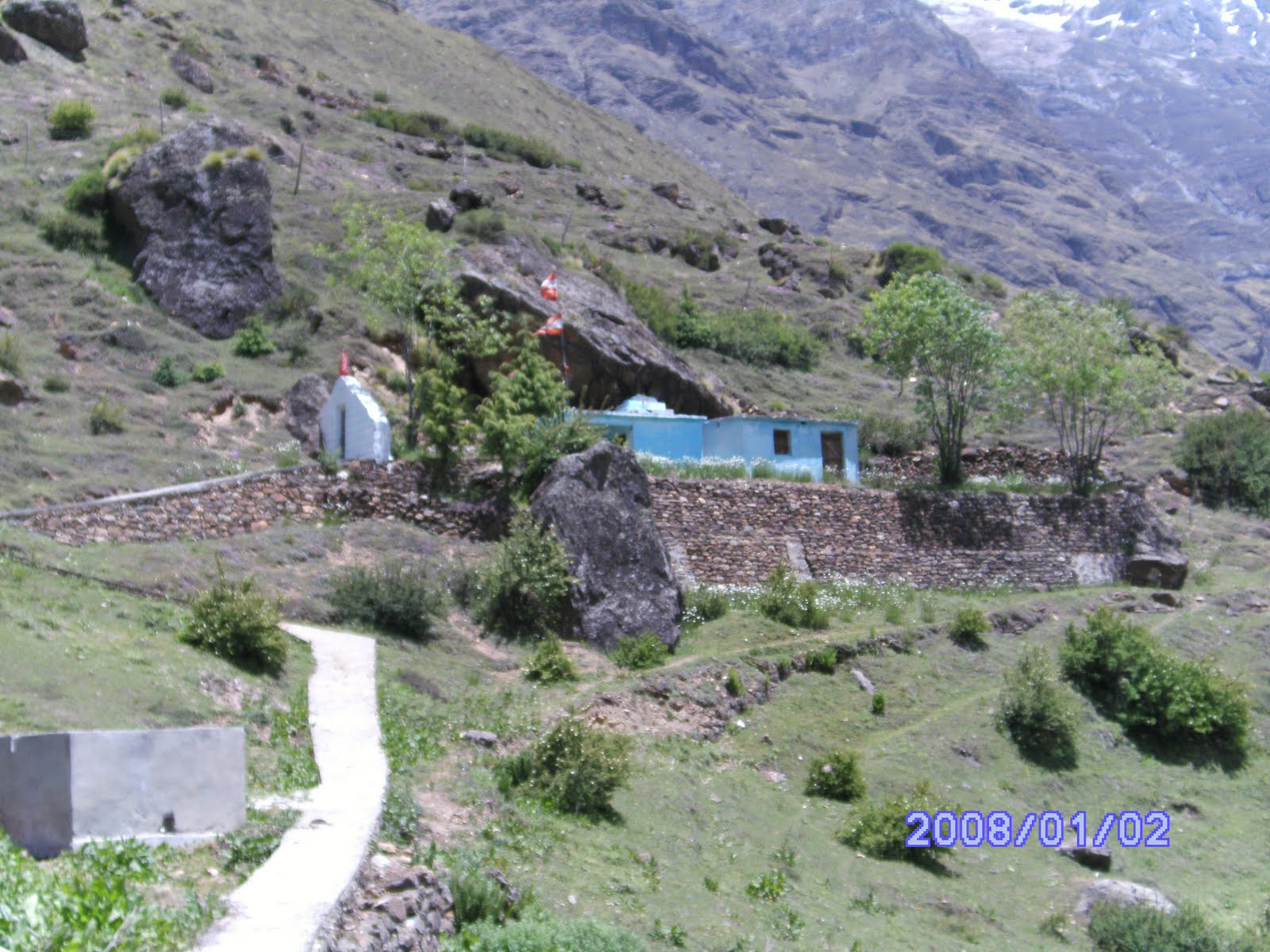
Below are some pictures for you (ignore the dates wherever printed on the pictures):
 ,
, Temple of Shree Badrinath Ji

The Lemon Juice Wallah on the Way

The Night Sky

Entrance to Village Mana

बंद गली का आखरी मकान.

Devprayag

Shree Ram Temple at Pandu Keshar

Neelkanth Mountain beyond Badrinath

VPO Mana
Near Mana

Triveni Ghat, Rishikesh




A typical house in Mana

Subscribe to:
Posts (Atom)
